
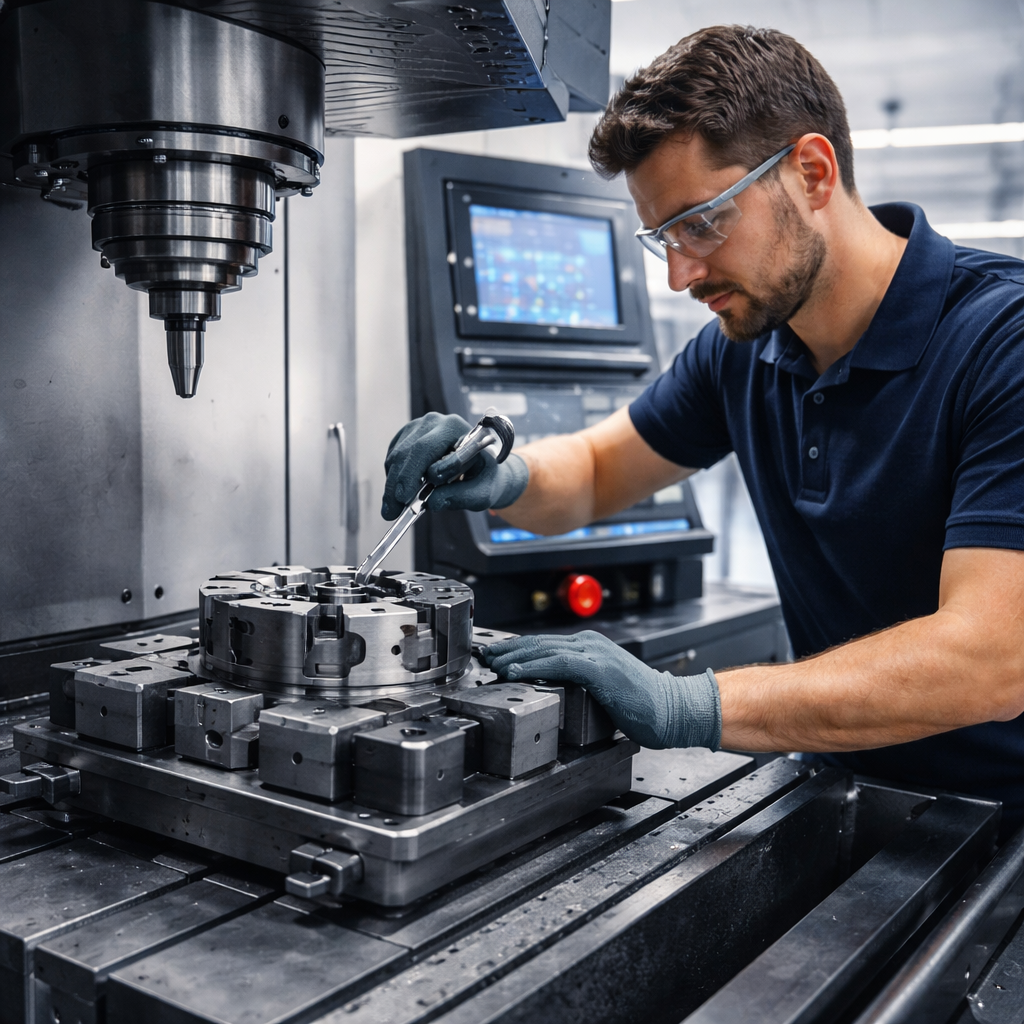
In modern manufacturing, the role of a workholding device in India has become more critical than ever. Whether in automotive, aerospace, or precision engineering, work holdings in Hyderabad and across India are driving efficiency, accuracy, and automation in CNC machining.
This article explores the history, evolution, current trends, applications, and benefits of workholding devices in CNC manufacturing.
What is a Workholding Device?
A workholding device is any tool or mechanism used to securely hold, locate, and support a workpiece during machining operations such as milling, turning, drilling, or grinding.
Common types include:
- Chucks
- Clamps
- Vices
- Fixtures and jigs
- Collets and pallets
These devices ensure stability, enabling precise machining and consistent quality.
History of Workholding Devices
1. Early Manual Workholding (Pre-Industrial Era)
The origins of workholding trace back to simple tools like wooden clamps and wedges. Craftsmen relied on manual techniques to stabilize workpieces.
- Highly skill-dependent
- Low repeatability
- Limited precision
2. Industrial Revolution & Standardization
With the rise of mass production in the 18th and 19th centuries, standardized parts became essential. Innovators like Eli Whitney introduced concepts that led to interchangeable manufacturing.
- Templates and guides evolved
- Birth of jigs and fixtures
- Improved consistency and productivity
3. Mechanical & Machine Tool Era
As machine tools advanced:
- Metal vices replaced wooden fixtures
- Workholding became stronger and more rigid
- Designed to handle higher cutting forces
4. CNC Era (Modern Workholding)
With the emergence of CNC machines:
- Precision requirements increased significantly
- Multi-axis machining demanded flexible workholding
- Devices evolved to support automation and repeatability
Improper workholding today can affect toolpaths, cost, and quality.
Evolution of Workholding in CNC Manufacturing
Modern CNC workholding has evolved in response to:
- High-speed machining
- Multi-axis operations
- Complex geometries
- Difficult materials
Manufacturers now require:
- High rigidity
- Better tool access
- Faster setup times
For example, newer designs allow machining on multiple sides while maintaining stability.
Present Trends in Workholding Devices in India
The demand for workholding devices in India is growing rapidly due to CNC adoption and Industry 4.0 transformation.
1. Automation & Smart Workholding
- Integration with sensors and IoT
- Automated clamping systems
- Reduced manual intervention
Smart workholding enables predictive maintenance and better machine communication.
2. Zero-Point Clamping Systems
- Quick changeover setups
- Reduced downtime
- Ideal for high-mix, low-volume production
3. Hydraulic & Pneumatic Workholding
- High clamping force
- Consistent performance
- Used in mass production
These systems improve efficiency and reduce setup time.
4. Modular & Flexible Fixtures
- Adaptable for multiple parts
- Cost-effective for SMEs
- Popular in work holdings in Hyderabad manufacturing clusters
5. Automation Integration (FMS & Robotics)
- Pallet systems and robotic loading
- Enables unmanned machining cycles
- Improves plant utilization significantly
Applications of Workholding Devices
Workholding devices are used across multiple industries in India:
1. Automotive Industry
- Engine components
- Transmission parts
- High-volume machining
2. Aerospace Industry
- Complex geometries
- Tight tolerances
- Lightweight materials
3. Medical Devices
- Precision implants
- Micro-machining
4. Electronics & General Engineering
- Small, intricate components
- High repeatability
Benefits of Workholding Devices
1. Improved Precision
Secure clamping ensures minimal movement, leading to high accuracy and better surface finish.
2. Increased Productivity
Efficient setups reduce machining time and increase throughput.
3. Enhanced Safety
Proper workholding prevents accidents caused by loose workpieces.
4. Reduced Setup Time
Modern systems like zero-point clamping allow quick fixture changes.
5. Cost Efficiency
- Less rework
- Lower scrap rates
- Better machine utilization
6. Compatibility with Automation
Workholding systems today are designed for integration with:
- CNC machines
- Robotics
- Smart manufacturing systems
Workholding Devices in Hyderabad: Growing Hub
Work holdings in Hyderabad are witnessing rapid growth due to:
- Expansion of aerospace and defense sectors
- Rise of precision machining industries
- Increasing adoption of CNC and automation
Hyderabad is emerging as a key manufacturing hub, creating demand for:
- Custom fixtures
- Hydraulic clamping systems
- Modular workholding solutions
Challenges in Workholding
Despite advancements, manufacturers face:
- Balancing rigidity and accessibility
- Handling thin or complex parts
- Managing vibration and deformation
- Designing cost-effective fixtures
High-speed machining amplifies any weakness in workholding systems.
Future of Workholding Devices
The future of workholding device in India is aligned with Industry 4.0:
- Smart, sensor-enabled fixtures
- AI-driven adaptive clamping
- Fully automated machining ecosystems
- Digital twin-based fixture design
With increasing demand for precision and automation, workholding will continue to evolve as a critical component of manufacturing success.
0 Comments